City Pop is a loose name for a constellation of urban-minded Japanese popular music associated with the 1970s and 1980s, where AOR, R&B, funk, jazz fusion and disco meet. Its boundaries move with records, compilers and listeners. The term works well as a direction of travel; it makes a less convincing border checkpoint. It asks how a city gets into a song: through carefully assembled sound, imagined lives elsewhere, and private feelings carried through public space. A record can inhabit several musical traditions at once. Decades later, another audience may decide that those traditions have been living on the same block.
The Tokyo photograph here was taken from the roof of the Ginza Dai-Ichi Hotel in March 1978. Tracks, roads, advertisements and towers crowd the sunset, exposing the city’s infrastructure of movement and work. Calling the whole period a “bubble era” loses an important sequence. Japan experienced oil shocks and other disruptions in the 1970s and early 1980s; the asset-price bubble accompanied expansion in the latter half of the 1980s. Records now gathered under City Pop cross those intervals. No one needs an economics course before pressing play. Keeping the uneven chronology in view simply leaves room for uncertainty as well as affluence.
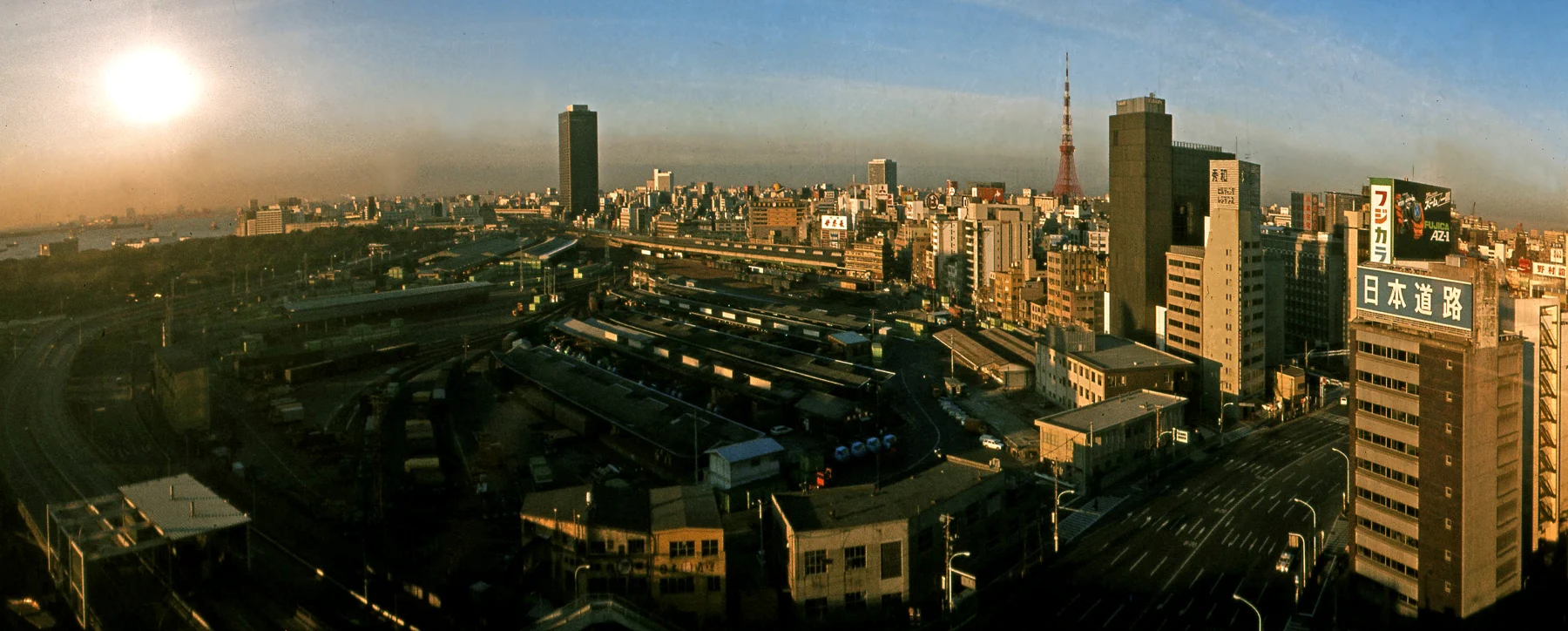 Tokyo from the roof of the Ginza Dai-Ichi Hotel, March 1978. Photograph by LBM1948, CC BY-SA 4.0, via Wikimedia Commons. Source CC BY-SA 4.0
Proportionally resized and converted to WebP for the web; no cropping or retouching.
A much smaller object changed the scale of listening. Sony introduced its first Walkman, the TPS-L2, on July 1, 1979, dispensing with recording and a loudspeaker in favor of stereo playback and lightweight headphones. The arrangement offered a particular sort of discretion to a person in transit: streets could determine the route while a chosen cassette supplied another itinerary. A portable player cannot account for the birth of a musical style. It does, however, give “urban music” a tangible additional meaning. The city becomes a space through which one carries sound, as well as a place a song might describe.
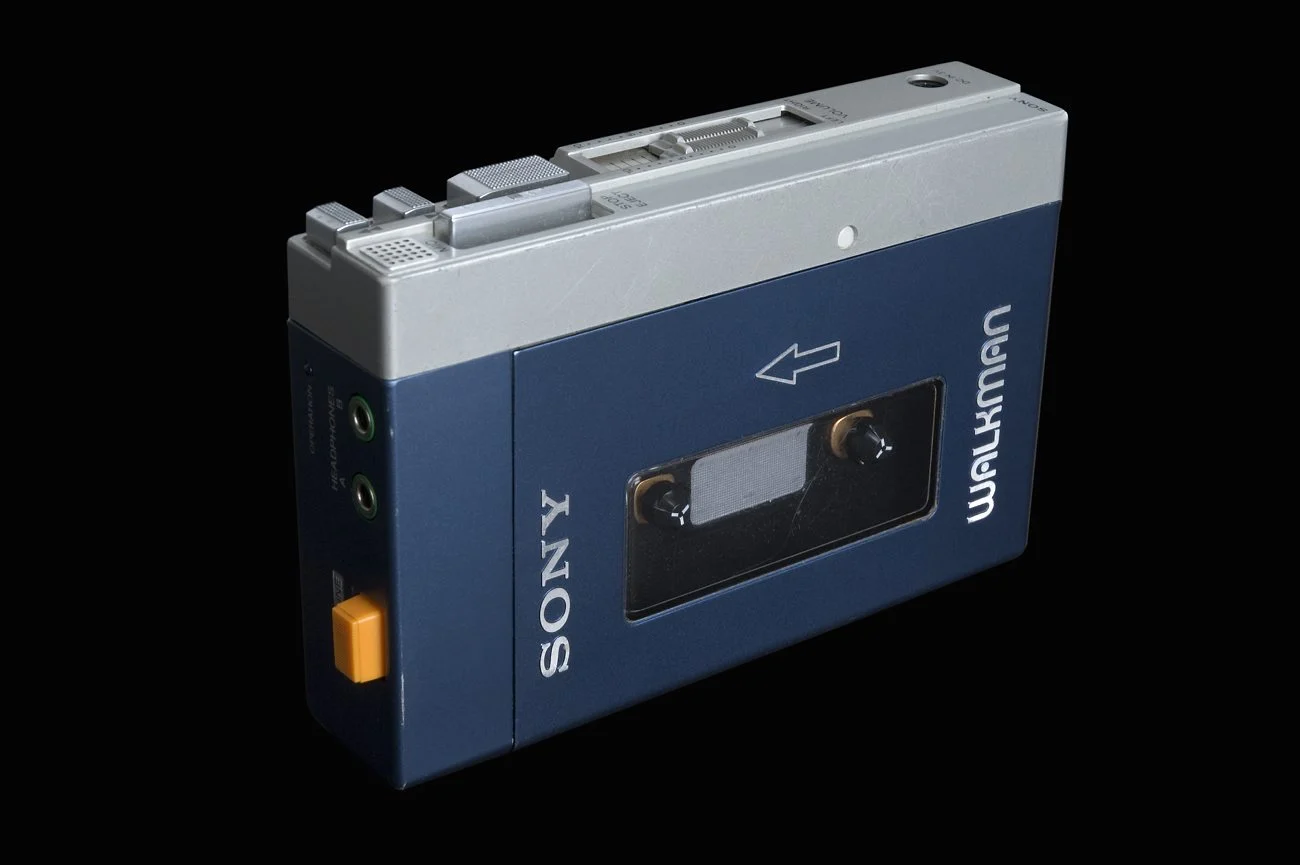 Sony’s TPS-L2 Walkman, introduced in 1979. This museum photograph was taken in 2006, not at the original launch. Anna Gerdén / Tekniska museet, CC BY-SA 3.0, via Wikimedia Commons. Source CC BY-SA 3.0
Proportionally resized and converted to WebP for the web; no cropping or retouching.
The record sleeve reveals another transport network. Taeko Onuki’s SUNSHOWER, released in 1977, credits Ryuichi Sakamoto with musical direction and arrangements; “Tokai” places Haruomi Hosono on bass, Chris Parker on drums and Tatsuro Yamashita among its background vocalists. On Mariya Takeuchi’s 1984 VARIETY, Takeuchi wrote every song’s words and music; Yamashita produced. These distinctions deserve their small print. Collaboration leaves authorship intact, while the name on the cover can only begin to account for a recording. Refinement, so readily treated as an atmosphere, is also a division of labor: particular people doing particular things, in relation to one another.
Why should music named for the city keep returning to pools, coastlines and clear skies? Hiroshi Nagai’s cover art offers one entrance. The Japan Foundation’s exhibition catalogue situates his resort imagery in an imagined American West Coast and Hawaii, shaped partly by the visual culture of consumption. Decades later, Light in the Attic commissioned him to paint the cover of Pacific Breeze. The city in City Pop can accommodate the wish to leave it. A seascape might describe a destination or reserve a little unoccupied space within daily life. Placing those images beside an actual streetscape lets the distance between an aspiration and a lived environment remain visible.
These records’ later lives have passed through many hands. In December 2020, Pony Canyon’s account of the renewed circulation of “Mayonaka no Door / Stay With Me” named club DJs, online curators and Indonesian singer Rainych, whose cover appeared that October. Light in the Attic’s Pacific Breeze compilations made another route available, joining collecting and selection to reissues with liner notes. The revival can be read as a new history of collaboration. Longtime listeners, first-time listeners and the people issuing records again arrive with different memories. A song need not wait for everyone to share the same past before it becomes something they can share.
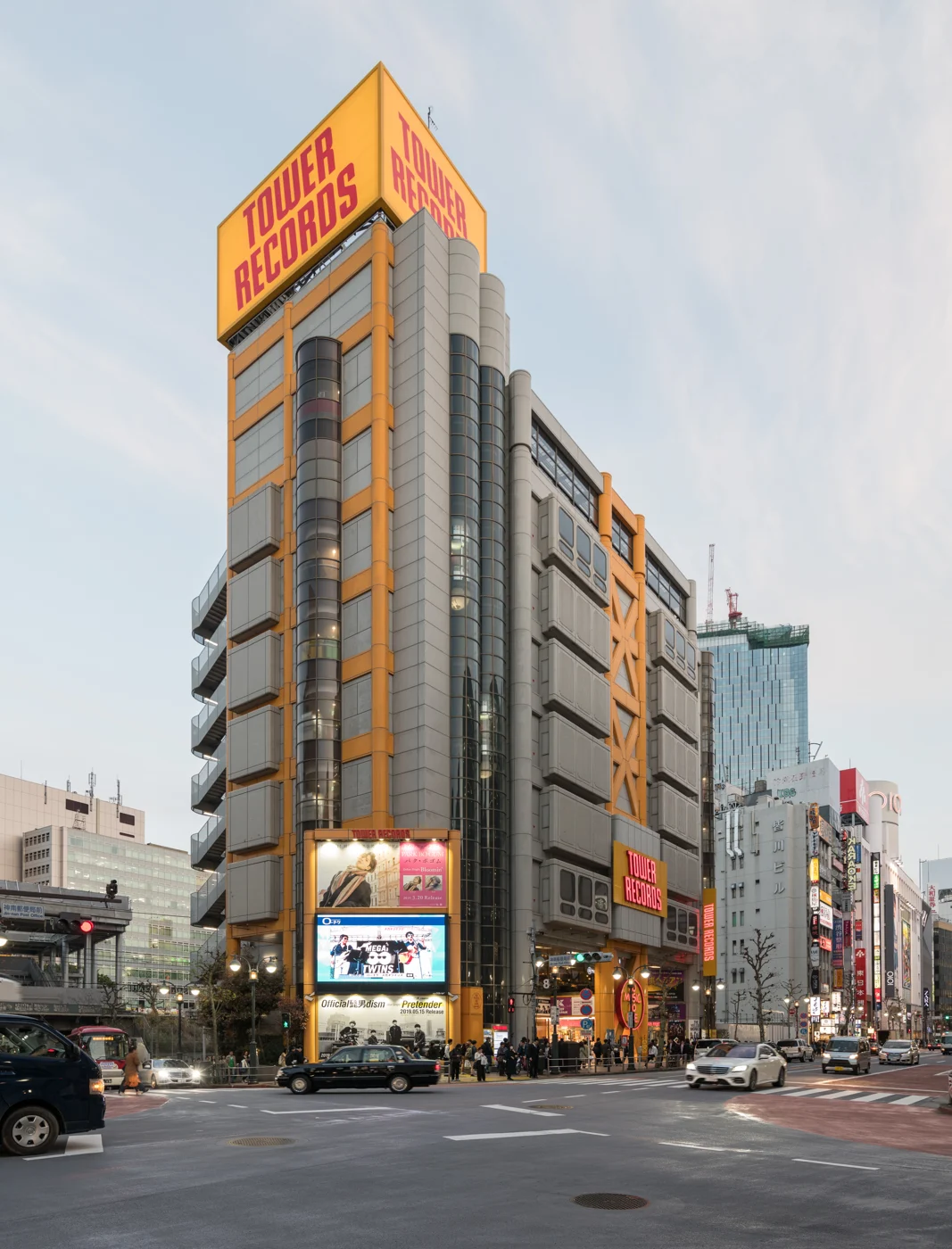 Tower Records in Shibuya, April 18, 2019. A photograph of a later record-retail environment, not a shop scene from the 1970s or 1980s. DXR, CC BY-SA 4.0, via Wikimedia Commons. Source CC BY-SA 4.0
Proportionally resized and converted to WebP for the web; no cropping or retouching.
City Pop Atlas begins with that possibility. Recognize a singer, then follow an arrangement or songwriting credit to someone unfamiliar. Set fame aside for a moment and see where a name appears next. The pleasure of a graph is that its central character can keep changing: a familiar chorus supplies an entrance, an easily overlooked collaborator becomes the next stop. Eventually, you may return to the original sleeve. It remains the same record. The city behind it has acquired a few more streets.
Collection scope & source notes
This is a representative collection in progress, not a complete catalogue of Japanese popular music. Some people and records are included as roots or neighboring contexts; inclusion is not a blanket City Pop classification. Works, recordings, releases, editions and track positions are distinguished where documented, so the entry count is not a count of unique songs.
Dates belong to the object described: original-release information is kept distinct from the date of a particular edition. Credits require checkable evidence. Album-level personnel are not automatically assigned to every track, and an absent credit does not establish non-participation. Entries retain their sources; cultural interpretation is distinguished from verifiable fact.
Chinese, English and Japanese share one graph. Official original titles are retained, and explanatory translations are not presented as official names. Documentary photographs identify their dates, creators and licenses; later photographs are not presented as scenes from the 1970s or 1980s. The coverage figures below describe the state of this archive.